Vesta project happens in domestic settings when encounters occur, and time and space allow it.
Its programing is being taken care by Anne Couillaud as well as invited curators, artists and writers. Vesta, the Roman goddess of hearth, and by extension home and family, is often symbolized by fire -or a fire stick-. In its New Delhi iteration, Vesta project happens in a private home. This is an alternative art space where exhibitions, talks and sometimes artist residencies take place that is open to the public. The intimate lived in space becoming a gathering place, accessible and organic in its nature.With Orhan Pamuk’s A modest Manifesto for Museums in mind, where people are encouraged to turn ”their own small homes and stories into “exhibitions spaces”, Vesta project invites artists and the public to converge in a liminal space for a night, a day, a week.
◆
Featured
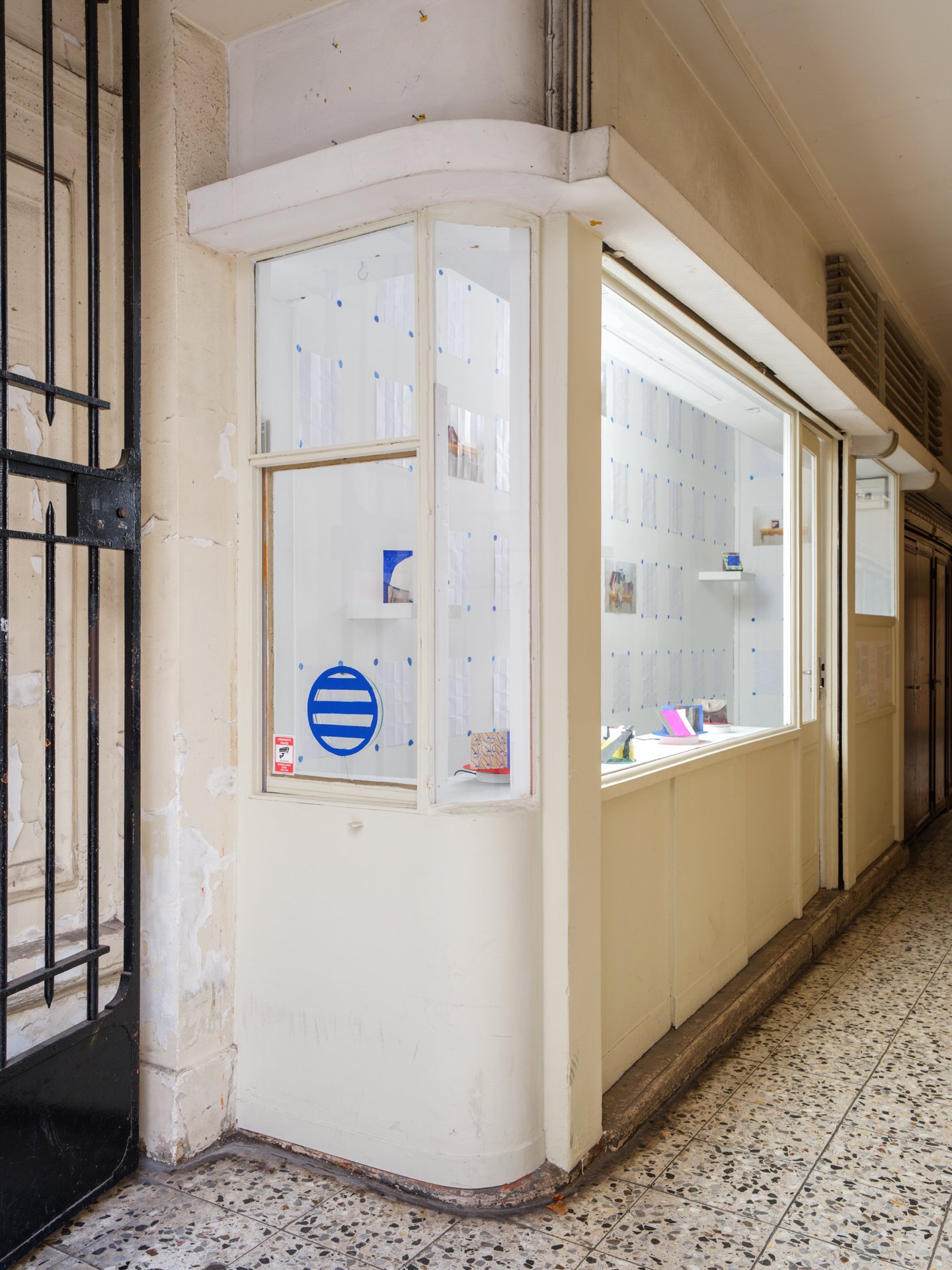
Nov 1-16 2025
Vesta Project / Au_Passage
curated by Anne Couillaud
Vernissage / Opening
Samedi 1er novembre - 14h à 18h / Saturday November 1st - 2-6 pm
Adresse / address
Passage Sainte-Anne - 59, rue Sainte-Anne 75002 Paris - Ouvert du Lundi au samedi de 9h à 19h / Open Monday through saturday 9 am until 7 pm
In Five & Dime—a title referencing the American variety stores that sold inexpensive goods, often for five or ten cents, and were popular throughout the last century—American artist Dawn Cerny presents seven small geometric paper sculptures displayed in a window at Passage Sainte-Anne. The choice—or rather, the constraint—of transporting the works by post from Seattle to Paris gave rise to flat forms which, once assembled through a system of cuts, become small abstract sculptures: miniature stabiles, light and ephemeral. Their surfaces, postcard-sized, are painted in gouache, at times with broad color fields, at others with repeated (or non-repeated) patterns. Some rotate slowly on small stands, others remain still.
The artist, whose larger-scale sculptures explore the tension between utilitarian objects and sculptural form, once again invites us to move away from strict formalism. With humor, and within this commercially scaled space, these sensitive abstractions question conventional notions of perception and value in the art world. Through these playful forms, Cerny initiates a reflection on aesthetic hierarchies. In their fragile materiality, she proposes a metaphor for relational and diplomatic dynamics. She invites us to consider how hospitality—within the context of an exhibition and beyond—necessarily involves a process of construction: how do we connect to the other, to others?
Here, lightness, ornamentation, and even excess are conceived as sincere gestures of resistance, countering the brutality of dominant narratives. Titles such as Milking Revolt In Situ or Marienbad Postcard echo these ideas. There is a gentle resistance at work—one that the American artist deliberately embraces—rooted in a poetics of discomfort and fragility, in an aesthetic of delicacy and impermanence. At the same time, Cerny demonstrates that through strategies of connection, even the most fragile matter can reveal a deeper resilience.
Dawn Cerny (born in Carpinteria, California) lives and works in Seattle, Washington. She earned a BFA (Bachelor of Fine Arts) from Cornish College of the Arts in 2002, and an MFA (Master of Fine Arts) from Bard College’s Milton Avery Graduate School of the Arts in 2012. In 2022, she was awarded the Joan Mitchell Fellowship. Her work has recently been featured in several institutional solo exhibitions, including at the Frye Art Museum, the Seattle Art Museum, and the Portland Art Museum, as well as in the garden project initiated by David Horvitz in Los Angeles (2025). Her sculptures and works on paper are part of public collections, notably at the Henry Art Gallery in Seattle, the Portland Art Museum, and the Seattle Art Museum. Her exhibitions and practice have been written about in Artforum, Bomb Magazine, the International Sculpture Center’s blog, The Stranger, and The Seattle Times. Dawn Cerny is currently an assistant professor at Seattle University.

Mario d'Souza. Home Away from Home Installation view, Vesta Project, New Delhi. Image courtesy of the artist.
January 2020 — Vesta project, New Delhi
Artist Mario d'Souza is in residence at Vesta Project in January 2020 and is creating a site specific installation here. Mario d'Souza (b.1973, Bangalore) studied in Baroda and then got a scholarship to study at Ecole des Beaux Arts in Paris where he still resides.
Recent projects: Galerie Until then in Paris / Ivry Art Center / Martell Foundation in Cognac / Oiron castle art center
Embodying the concept of “Home away from home” that has been running through his practice for the last decade, artist Mario d’Souza transforms a room in a Delhi apartment into a site specific installation. The artwork embeds here his idea of “home” into a domestic space for the first time. From a bamboo structure—that can be understood both as an exoskeleton and an endoskeleton of a room—hang shimmering velvets in bright hues and matte fabric panels in more subdued tones. Appearing through these curtains are sanguine drawings of plants and hands on colored paper, and on the floor, a multitude of objects rest, spreading themselves in a manner at times whimsical, at times contained: more drawings, papier maché birds, bark-made flowers, wood sticks, a bowl, a bolster, terracotta fruits replicas, vibrant green leaves, folded and unfolded bright pieces of silk and brocade… a solemn ebullience. D’Souza attained this spatial equilibrium through an intense and precise intuitive ordering day after day: the process that lead to these poetic appositions possibly being the artwork itself. The completed installation evokes an archipelago, a landscape, but also an Indian bazaar where each object tells a story: of its maker, his gestures and of its user.
D’Souza’s negotiation of two cultures—Indian and French (he has been living in France for the past 18 years) quietly emerges through his practice: here for instance in how the drapery evokes Indian miniatures or palaces as well as tapestries hanging in French castles. His two year long residency at Mobilier National in Paris working among dedicated craftsmen enriched his work where there is no distinction between decorative arts, crafts and fine art. The artist forcefully embraces the juxtaposition of histories and geographies embedded in each of the objects and fabrics displayed—for instance in the velvet or brocade. He also embraces the precious and the mundane —the Auroville marble paper or the machine made A4—the natural and the artificial, the masculine and the feminine…firmly believing in the AND.
The biographical often meets the decorative in this installation that D’Souza refers to as a three dimensional miniature painting. Antique painted terracotta fruits used for rituals lay on folded fabric, bringing the idea of nature indoors while also referring to the very first sculptures the artist came across as a child during Dussehra in his hometown of Bangalore. However, the broader idea of ritual exceeds this specific reference as the entire room feels like an offering to oneself and to the viewer. Gravity, materialized by the velvet strips, is not only a matter of physics here, it is also a feeling. This profusion of tactile forms and colors invites the viewer to reflect on the psychological and imaginative dimensions of the home—home as a place, home as a portrait.
Born in 1973 in Bangalore, Mario d’Souza lives and works in Paris.
The artist and Vesta Project would like to thank the Martell Foundation in Cognac, France, for making this 3 months long work trip in India possible.

Olaf Stapledon. Last and First Men: A Story of the Near and Far Future. New York: Magnum. [1930] 1978.
January 4th, 2019 — Vesta project, New Delhi
Tyler Coburn is an artist and writer based in New York. His work has been presented at South London Gallery; Kunsthalle Wien; CCA Glasgow; Western Front, Vancouver; Bergen Kunsthal; Grazer Kunstverein; Para Site, Hong Kong; and Sculpture Center, New York. Coburn participated in the 11th Gwangju Biennale and in the 10th Shanghai Biennale. His writing has appeared in e-flux journal, Frieze, Dis, Mousse, and Rhizome.
Ergonomic Futures is a multi-part project that asks questions about contemporary “fitness” through the lens of speculative evolution. The work comes out of Tyler Coburn’s interviews with paleoanthropologists, ergonomists, evolutionary biologists, and genetic engineers. To each he has asked: What are future scenarios for imagining new types of human bodies, and how might this thought experiment reframe conversations about body normativity in the present day?
Over the course of forty minutes, Coburn will discuss genetic engineering, the founder effect, postplanetary living, and other things that contribute to marked differences in how we biologically, philosophically, and legally define the “human.”
Tyler Coburn